Our WordPress Development Process: Eight Phases, Zero Guesswork

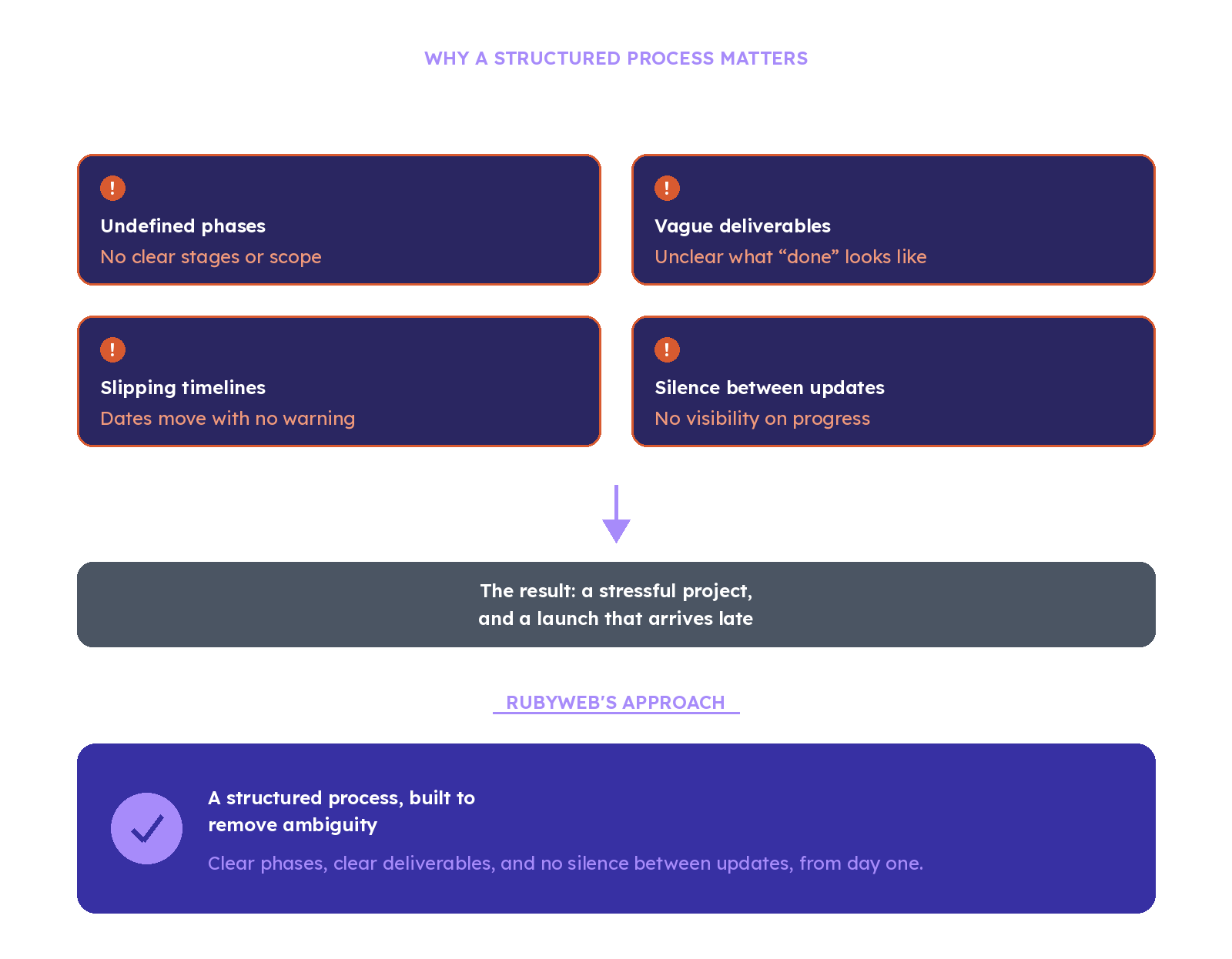
The most common reason web projects fail isn’t the technology and it isn’t the design. It’s the absence of a structured process – clear phases, defined deliverables, agreed timelines, and a communication rhythm that keeps everyone informed at every stage. RubyWeb’s WordPress development process was built to eliminate the ambiguity that makes web projects stressful and the gaps that make them run late.

Every project we take on – regardless of size, scope, or market – runs through the same eight phases. Not because we’re rigid, but because structure is what makes delivery predictable. And predictable delivery is what makes a web project a good experience rather than an anxious one.

— Our Process

Why a Structured WordPress Development Process Matters

Unstructured web projects fail in predictable ways. Scope creeps because it was never clearly defined. Timelines slip because dependencies weren’t mapped upfront. Revisions multiply because expectations weren’t aligned before work began. The website launches on a Friday afternoon and something breaks over the weekend with no one monitoring. Each of these is preventable with the right process in place from the start.

Our eight-phase process was designed around those failure points. Each phase exists because skipping it creates a problem downstream. The UX audit prevents building on a false assumption. The wireframes prevent expensive design revisions. The content finalization phase prevents a launch delay caused by missing copy. The Tuesday-to-Thursday launch window prevents a weekend incident with no one available to respond.

The process also gives US clients visibility and confidence. You always know which phase your project is in, what’s been completed, what’s in progress, and what’s coming next. There are no status updates you have to ask for. The communication cadence is agreed before the project starts, and it runs throughout.

— 8 Delivery Steps

The Eight Phases of Every RubyWeb Project

Each phase has a defined purpose and a defined output. Nothing moves forward until the output of the previous phase is complete and agreed.

Phase 01

UX / UI Audit

Purpose

Before we plan anything, we understand what you have and what it’s currently doing. For new builds on an existing site, we audit the current digital presence: what’s working, what’s not, where users are dropping off, and what assumptions the existing design is making that may not be correct. For greenfield builds, we conduct a discovery session to establish goals, audience, competitive context, and the specific outcomes the new site needs to deliver. No assumptions, no copy-paste solutions from the last project.

Outcome

A clear brief: a documented understanding of the business goals, the target audience, the conversion outcomes the site needs to achieve, and the specific problems the project needs to solve. This becomes the reference point for every decision made in the phases that follow.

Phase 02

Project Planning

Purpose

With the brief established, we scope the project in detail: pages, functionality, integrations, design requirements, content needs, and any third-party systems that need to be connected. From the scope, we build the project plan: phases, milestones, dependencies, client input requirements, and the communication cadence for the duration of the project. The 50% deposit is invoiced at this stage, which confirms the project start date and secures the delivery team’s capacity.

Outcome

A signed-off project plan that both teams – RubyWeb and the client – have reviewed and agreed on. Timeline, milestones, communication schedule, and the specific inputs the client needs to provide at each stage are all documented before any design work begins.

Phase 03

Wireframes

Purpose

Wireframes define the structure and user flow of the site before any visual design begins. This is where we map how visitors navigate through the site, where content sits on each page type, what the conversion pathways look like, and how the architecture serves the goals established in the UX audit. Wireframes are low-fidelity by design – they’re about structure, not aesthetics. This phase prevents the most expensive kind of change: a structural revision after the visual design has been completed.

Outcome

Wireframes for all key page templates, reviewed and approved by the client. Agreement on site architecture, page structure, navigation logic, and conversion pathway design – before a single design decision is made. Changes at the wireframe stage cost a fraction of changes at the design or development stage.

Phase 04

Design

Purpose

With the structure agreed, visual design begins. We build the design from the client’s brand identity – color system, typography, imagery style – and apply it consistently across all page templates and components defined in the wireframes. Design is developed iteratively with defined client feedback checkpoints. We don’t present a finished design and ask for approval in one round. We share progress at key stages, incorporate feedback, and advance to the next level of detail once agreement is reached. Development does not begin until the design is signed off.

Outcome

A complete, approved visual design covering all page templates, component states, and responsive behavior guidelines. A design system that the development team can implement with precision and that the client can reference for all future additions to the site.

Phase 05

Content Finalization

Purpose

Content finalization is the phase that most clients underestimate and that causes the most schedule slippage on web projects industry-wide. We manage against this explicitly. Before development begins, all copy, images, and assets for every page in scope must be confirmed and ready to load. We work with clients well in advance of this deadline to identify what content exists, what needs to be written or sourced, and who is responsible for delivering each element. We do not begin development against missing content.

Outcome

All content – copy, images, logos, videos, documents, and any other assets – confirmed, approved, and ready for the development team to build against. A site built on placeholder content is a site that will need revision after development. We prevent that by ensuring content is final before a line of code is written.

Phase 06

Development

Purpose

Development is the build phase: WordPress installation, theme and plugin configuration, custom development of any functionality outside standard WordPress capability, content loading, and integration setup for any third-party systems. We build with clean, documented code following WordPress coding standards. Progress updates are provided throughout the development phase – not just at the end. Clients can see the site developing on a staging environment and raise questions as they arise.

Outcome

A complete WordPress build on a staging environment: all pages built, all content loaded, all functionality working, all integrations connected and tested at the integration level. The site is ready for the testing phase before any launch date is discussed.

Phase 07

Testing & UAT

Purpose

Testing covers two distinct activities. Internal QA first: we test the site across all major browsers, devices, and screen sizes; we test all functionality including forms, integrations, and any custom features; we test performance against Google Lighthouse benchmarks and ensure Core Web Vitals are within acceptable thresholds. Once internal QA is complete, the client begins User Acceptance Testing (UAT) – a defined period where the client reviews the build against the original brief and signs off on any remaining changes. Nothing goes to launch without a formal UAT sign-off.

Outcome

A tested, signed-off site ready for launch. A Google Lighthouse benchmark report documenting performance across all four categories. A zero-critical-issues QA sign-off from the RubyWeb team and a formal UAT sign-off from the client. The launch date is only set after both are in hand.

Phase 08

Launch

Purpose

We launch on Tuesdays, Wednesdays, or Thursdays only. Never Mondays, Fridays, or weekends. This isn’t a preference – it’s a delivery standard based on a simple operational reality: if something unexpected occurs during or immediately after a launch, the full team needs to be available to respond. End-of-week and weekend launches create risk that a mid-week window eliminates. Launch day includes DNS cutover (where applicable), post-launch monitoring, and a final Lighthouse benchmark run on the live domain. The client receives the full handoff package: documentation, CMS training, the Lighthouse report, and – for every project – an offer for ongoing monthly maintenance.

Outcome

A live, fully functioning WordPress website with documented performance benchmarks, complete handoff documentation, CMS training for the client team, and a clear path to ongoing support through a Monthly Care Plan. The project is closed when the client confirms they can manage the site independently.

— Why It Works

The Three Things Our Process Is Designed to Deliver

Transparency

You always know where your project stands. The project plan is shared and updated. Milestones are visible. Progress updates don’t require you to ask for them. When something changes – a timeline shift, a scope question, a decision that needs your input – we communicate it immediately and directly. There are no surprises at launch because there are no surprises during the project.

Predictability

Structure makes delivery predictable. When phases are defined, dependencies are mapped, and client inputs are scheduled in advance, projects move through the pipeline without the stalls and restarts that characterize unstructured agency relationships. We know from experience where projects typically slow down – content finalization, design approval, UAT feedback turnaround – and we build protective time and process around those points proactively.

Quality Control

The process is a quality control mechanism. Wireframes before design prevents structural problems. Design sign-off before development prevents mid-build redesigns. Content finalization before development prevents placeholder-driven launches. Internal QA before UAT prevents avoidable client-facing issues. Lighthouse benchmarking before launch ensures performance is measured, not assumed. Each phase gate exists to catch the class of problem that slips through when it’s absent.

— Why RubyWeb

How the Process Works for US Businesses Working With a Remote Team

Most of the hesitation US businesses have about working with a remote team comes down to two things: communication and accountability. Both are process problems, and our process addresses them directly.

Communication Structure

Every project has a single point of contact – your dedicated project manager – who is responsible for all communication throughout the engagement. Weekly status updates are sent every Friday covering what was completed that week, what’s in progress, what’s scheduled for the following week, and any decisions or inputs we need from you. You receive a shared project tracker that you can check at any time. You never have to ask what’s happening.

For scheduled feedback rounds – wireframe review, design approval, UAT – we agree on the review period and the feedback format upfront. You know exactly when you’ll need to be involved and what we need from you at each stage. Client involvement is structured and time-efficient, not open-ended and unpredictable.

Timezone Handling

We operate across South African and US business hours. The majority of project communication – updates, questions, feedback responses – is handled asynchronously, which means the time zone difference is a scheduling consideration, not a delivery barrier. Scheduled calls, review sessions, and milestone meetings are arranged at times that work for US time zones. In practice, most US clients find the async communication model more organized and less intrusive than the availability-dependent communication style of local agencies.

Project Management Tools

We use a shared project tracker for every engagement – a live document that both teams can access, showing the current phase, completed tasks, outstanding items, upcoming milestones, and any open decisions. The tracker is updated throughout the project and is the authoritative reference point for the current status of the engagement. When questions arise about what’s been agreed, what’s been completed, or what’s next – the tracker has the answer.

Accountability

We hold ourselves to the timelines we agree to. When something is going to shift – because of a dependency, a third-party delay, or a scope question that needs resolution – we communicate it immediately, explain the cause, and propose a revised path forward. We don’t wait until a deadline passes to tell you it’s been missed. Accountability in a remote engagement means proactive communication about problems, not reactive explanations after the fact.

Frequently Asked Questions

A standard WordPress website build runs 6–12 weeks from project kickoff to launch, depending on scope, design complexity, and content readiness. A WooCommerce store typically runs 8–14 weeks. Custom development projects with complex functionality or integrations are scoped and timed individually. Timelines are agreed at the project planning phase and tracked throughout. The most consistent cause of timeline extension is content - copy and images that aren’t ready when development needs to begin. We manage against this actively and will tell you clearly and early what we need from you and when.

Client involvement is structured and concentrated at specific points rather than spread across the whole project. The heaviest periods of involvement are the discovery and UX audit phase (sharing context about your business and goals), wireframe and design review (one or two structured feedback rounds), content finalization (providing or approving all content), UAT (reviewing the completed build), and post-launch CMS training. Outside of those phases, your main involvement is reviewing the weekly status update and responding to any questions that arise. Most clients tell us the time commitment is lower than they expected.

Our design process includes defined feedback checkpoints at each stage of design development - concept direction, mid-design review, and final approval - so revisions are collected and addressed in structured rounds rather than as ongoing requests. We don’t put a blanket revision limit on design work because that creates an incentive to rush approvals. What we do require is that feedback is consolidated within the client team before it’s submitted, so we’re not managing contradictory feedback from multiple stakeholders. Structural changes after design sign-off or development changes after UAT sign-off are scoped and priced as change requests.

Changes happen, and we handle them practically. Minor changes within the agreed scope are accommodated without a formal process. Changes that affect scope, timeline, or budget are handled as change requests: we document what’s changing, what the impact on timeline and cost is, and we get sign-off before proceeding. This isn’t bureaucracy for its own sake - it’s the mechanism that keeps the project moving predictably and prevents scope creep from creating timeline and budget surprises at the end.

Because if something unexpected happens on or immediately after launch, we need the full team available to respond. End-of-week launches mean a Friday incident gets limited response until Monday. Weekend launches mean the same, with less monitoring capacity. Mid-week launches mean any issue that arises is addressed immediately, by the people who built the site, with a full working day ahead of them. It’s a small constraint with a meaningful risk reduction behind it.

Every project client receives a handoff package at launch: full site documentation, CMS training (live session and recorded), Google Lighthouse benchmark report, and confirmation of all third-party configurations. We also offer a Monthly Care Plan at handoff - proactive maintenance, security monitoring, plugin updates, backups, and uptime monitoring on a flat monthly fee. The care plan keeps the site performing after launch and gives clients a direct line to the team for questions and minor changes. We’re built to be a long-term partner, not a one-time vendor.

Google Lighthouse is an open-source performance auditing tool built into Chrome DevTools and used by Google to assess the quality of web pages across four categories: Performance, Accessibility, Best Practices, and SEO. Lighthouse scores directly influence Google’s assessment of your site’s user experience, which feeds into organic search rankings. We benchmark every site against Lighthouse before launch because it gives us - and our clients - an objective, measurable record of the site’s quality at the point of handoff. It’s not a vanity metric. It’s the standard Google holds websites to.

Ready to Start a Project With a Process You Can Actually Trust?

Tell us about your website and what you need it to do. We’ll run you through the process, scope the project, and come back with a clear recommendation - no jargon, no pressure.